The Antenna Problem Is Really a Computational Electromagnetics Problem
 R. Kessler
Antennas are supposed to be solved. Dipoles, patches, phased arrays: the theory goes back decades, some of it centuries. So why are defense programs consistently slipping schedules and blowing budgets on antenna integration? The answer is not the antenna. The answer is the compute required to make modern antennas do what operators actually need them to do.
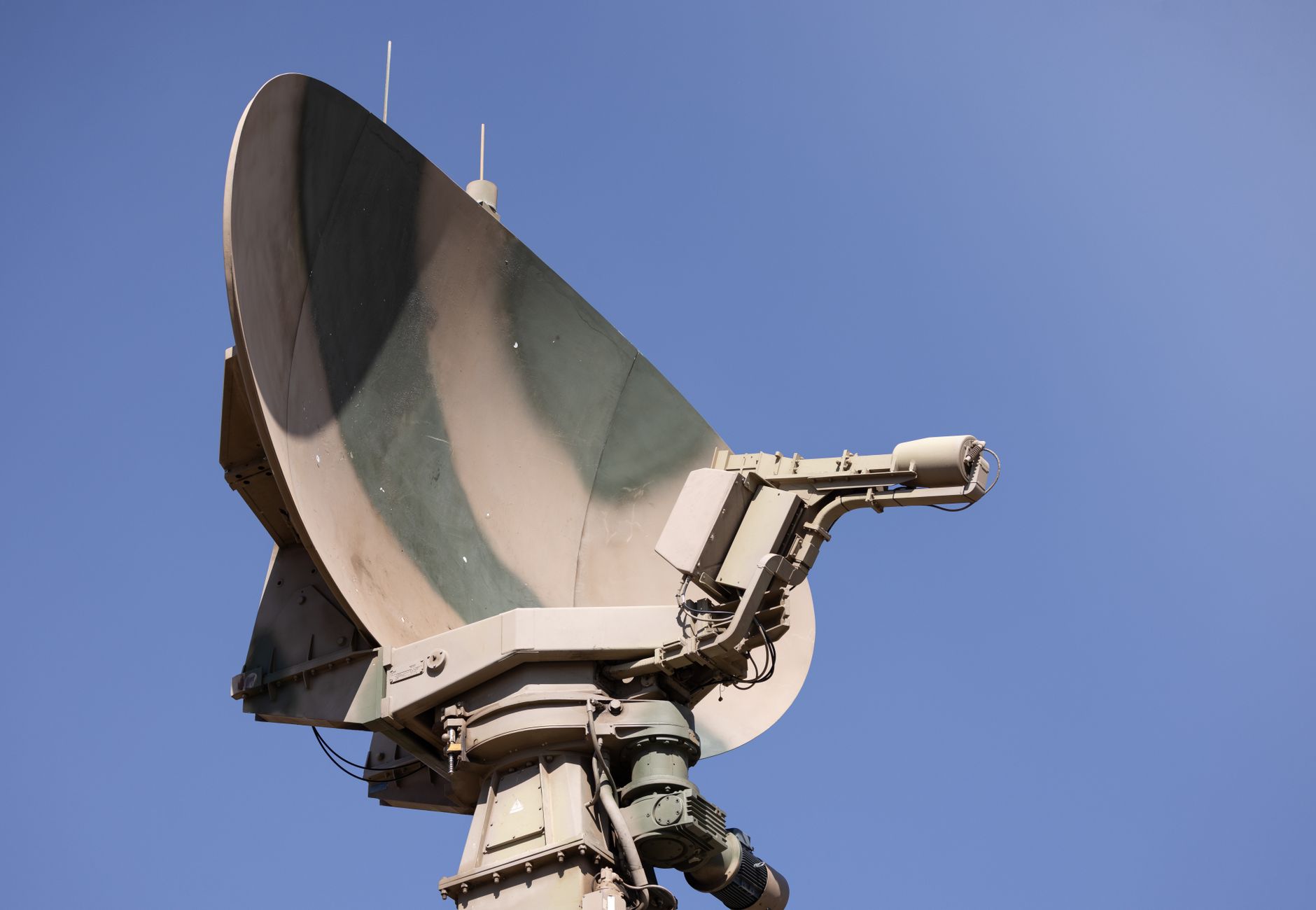 Photo by Magda Ehlers on Pexels.
Put plainly: today's antenna problem is a computational electromagnetics problem.
What Changed
Classical antenna design assumes relatively stable boundary conditions. You pick a frequency, a radiation pattern, a substrate, and you optimize. The math is hard but tractable. Tools like HFSS and CST have been doing this for decades with reasonable fidelity.
What those tools were not built for is what defense platforms now demand: conformal antennas embedded in carbon fiber airframes, apertures that share physical space with sensors from three different vendors, wideband operation across bands that used to belong to separate systems, and all of it crammed into a volume budget that would have been considered absurd in 2005. The geometry is no longer simple. The materials are no longer linear. The interactions between antenna elements and surrounding structure are no longer ignorable.
Full-wave electromagnetic simulation of a modern fighter's entire airframe, including all installed antennas and their mutual coupling effects, requires solving Maxwell's equations across a geometry measured in thousands of wavelengths at the frequencies of interest. That is not a laptop problem. At X-band, a single full-airframe simulation can take weeks on a mid-sized HPC cluster, and that is one configuration, one frequency sweep, one loading condition.
Defense programs that skip this step discover the mutual coupling problem on the range instead of in the simulation. That discovery is expensive.
The Installed Performance Gap
There is a specific failure mode worth naming. An antenna vendor delivers a component that meets every spec on paper, tested in an anechoic chamber in isolation. The antenna gets installed on the platform. Performance degrades. The vendor says the antenna is fine. The integrator says the installation is correct. Both are right. The problem is the interaction between the antenna and the platform, which nobody modeled with sufficient fidelity.
This is the installed performance gap, and it shows up on nearly every complex defense platform. Submarines with conformal hull arrays. Helicopters where rotor blade interference appears at certain rotation rates. Ground vehicles where antenna placement had to be optimized around armor geometry that was finalized late in the program.
Solving this gap requires co-simulation: the antenna design tool talking to a full-wave solver that has an accurate model of the surrounding structure, which itself requires the CAD model to be accurate and current. That last part is harder than it sounds, given what the existing posts on this site have said about the digital thread breaking in defense manufacturing.
Where the Compute Is Going
Three approaches are converging on this problem.
graph TD
    A[Platform CAD Model] --> B(Full-Wave EM Solver)
    C[Antenna Element Design] --> B
    B --> D{Installed Performance Model}
    D --> E[Pattern & Coupling Data]
    E --> F(Digital Beamforming Algorithm)
    F --> G[Adaptive Waveform Output]
First, GPU-accelerated solvers. Companies like Remcom and Ansys have been pushing FDTD and MoM solvers onto GPU clusters. The throughput improvement over CPU-only runs is real, often ten to thirty times faster for large problems, which moves certain simulations from weeks to days. That matters when you are iterating antenna placement during an integration review.
Second, reduced-order models trained on full-wave simulation data. If you run enough high-fidelity simulations, you can train a surrogate model that approximates the behavior of the full solver for nearby configurations in seconds. This is where machine learning is earning its keep in RF engineering, not generating antenna designs from scratch, but accelerating the parametric sweeps that dominate design iteration time.
Third, digital twins with live measurement feedback. Some programs are now building antenna performance models that ingest real measurements from installed sensors and update the simulation state accordingly. The simulation becomes a living model rather than a one-time prediction. When performance drifts, you have a basis for diagnosing why.
The Skills Problem Underneath
None of these tools work without people who understand both the electromagnetics and the computational side. That combination is genuinely rare. A solid RF engineer who can also set up and interpret a large-scale parallel FDTD simulation, understand numerical dispersion errors, and debug meshing artifacts is not a profile that rolls off university production lines in quantity.
Defense contractors have largely handled this by keeping small teams of experts who become bottlenecks on every major program. The democratization of these tools, through better GUIs, cloud-based solver access, and AI-assisted mesh generation, is helping at the margins. But the underlying knowledge gap between what the tools can do and what most engineers can extract from them remains wide.
The antenna is not the problem. The antenna was never the problem. What sits between the antenna and a working system is a computational challenge that the industry has been quietly struggling with for years. The platforms getting this right are the ones investing in the compute and the people simultaneously, treating electromagnetic simulation as a first-class engineering discipline rather than a checkbox before hardware delivery.
Get Bits Atoms Brains in your inbox
New posts delivered directly. No spam.
No spam. Unsubscribe anytime.