The Logistics Robot Problem Is Actually a State Estimation Problem
 R. Kessler
Everyone wants to talk about legs, wheels, and payload capacity when the subject is autonomous military logistics. Walk into any program review on contested resupply and the slides are full of actuators, torque curves, and terrain clearance numbers. Almost nobody wants to talk about the thing that actually breaks these systems in the field: the robot doesn't know where it is, what's around it, or how confident it should be about either.
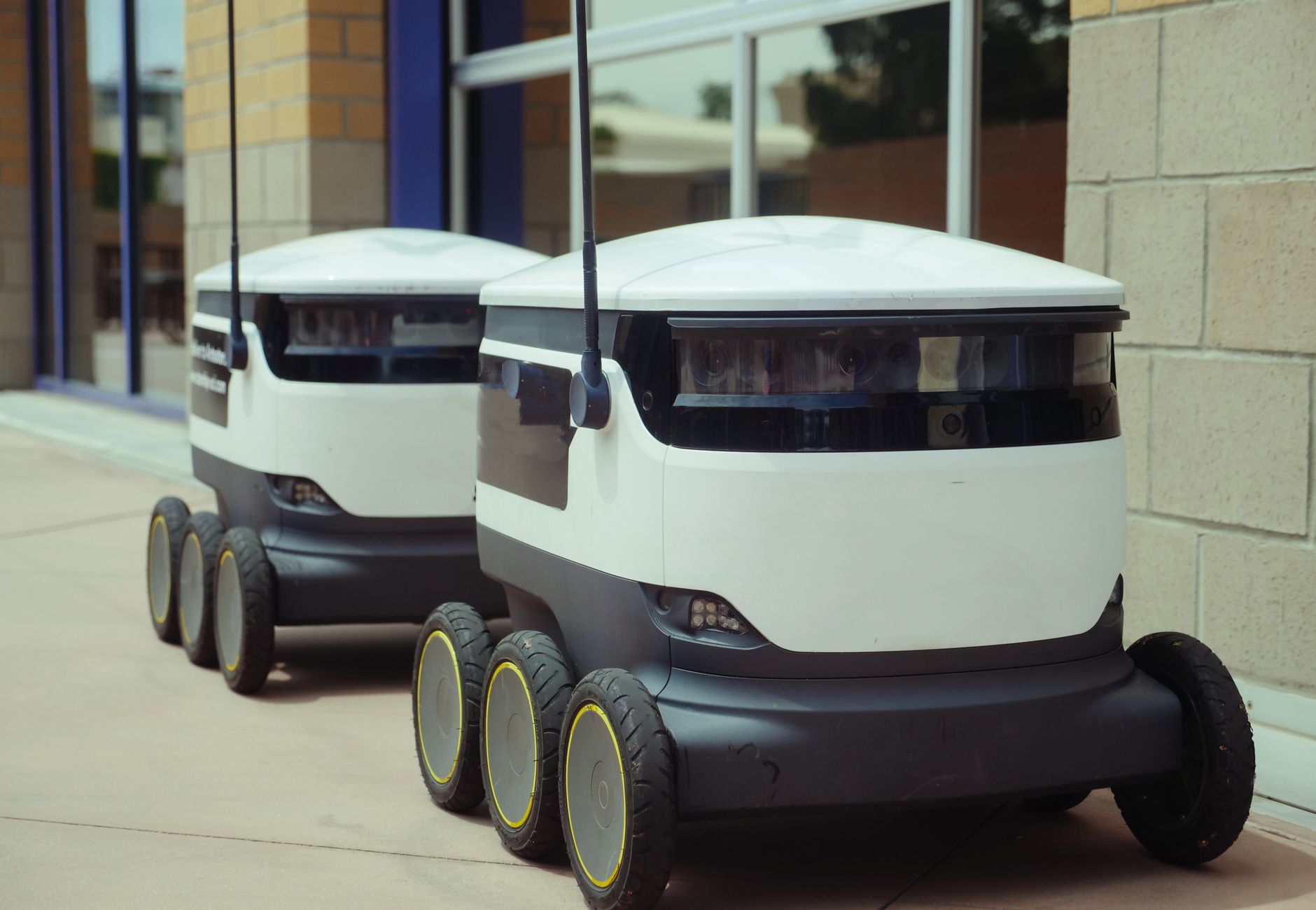 Photo by Kindel Media on Pexels.
That's a state estimation problem, and it's a much harder one than the mobility hardware suggests.
Consider what an autonomous resupply vehicle has to do in a degraded environment. GPS is jammed or spoofed. The terrain hasn't been mapped recently, if ever. Other vehicles, dismounted troops, and civilians are moving through the same space unpredictably. The robot needs a continuously updated estimate of its own position, velocity, and orientation, plus a probabilistic model of everything nearby that might collide with it or that it needs to avoid. Get that estimate wrong by even a few degrees of heading error compounded over distance, and a resupply drone meant for a forward position ends up somewhere useless, or worse, somewhere it shouldn't be.
Why this is harder than commercial robotics
Warehouse robots and delivery drones solve a version of this problem, but under much friendlier conditions. Known maps. Controlled lighting. No one actively trying to spoof their sensors. Defense logistics robots have none of these luxuries, and they have to fuse data from unreliable, intermittently available sources: degraded inertial measurement units, vision systems in smoke or dust, lidar that struggles with foliage, and radio-based ranging that's exactly the kind of signal an adversary wants to jam.
The sensor fusion challenge isn't just technical, it's statistical. Every sensor carries uncertainty, and that uncertainty has to be modeled honestly rather than averaged away. A Kalman filter or particle filter that assumes clean, independent Gaussian noise will quietly diverge when the real noise is correlated, biased, or adversarially manipulated. Defense logistics platforms need estimators built to survive sensors lying to them, not just sensors being a little noisy.
graph TD
    A[IMU] --> E{State Estimator}
    B[Visual Odometry] --> E
    C[Lidar/Radar] --> E
    D[RF Ranging] --> E
    E --> F[Position & Uncertainty Estimate]
    F --> G[Path Planning]
    G --> H((Actuation))
The uncertainty budget nobody writes down
Most logistics robotics programs still treat localization as a solved subsystem, something you buy off the shelf and bolt on. That assumption falls apart the moment the operating environment gets adversarial. A resupply robot moving through a contested corridor needs an explicit uncertainty budget: how much position error can it tolerate before a planned route becomes unsafe, and how does that budget change as GPS denial, jamming, or sensor degradation stacks up over the mission?
This is where defense requirements diverge sharply from commercial robotics roadmaps. Commercial delivery drones optimize for average-case efficiency. Defense logistics platforms have to optimize for worst-case survivability of the estimate itself, because a confidently wrong position is more dangerous than an honestly uncertain one. A robot that knows it doesn't know where it is can slow down, request help, or fall back to a conservative behavior. A robot that's wrong and sure of it drives straight into trouble.
What actually needs to change
The fix isn't a better sensor. It's better estimation software that treats every input as provisionally untrustworthy, fuses redundant and dissimilar sensing modalities (inertial, visual, acoustic, RF), and propagates uncertainty all the way through to the planning layer instead of collapsing it into a single point estimate too early.
That means investment has to shift from mobility hardware, which is mostly mature, toward the probabilistic software stack that interprets what the hardware is sensing. The vehicles that will actually survive contested resupply missions won't be the ones with the best legs or the biggest batteries. They'll be the ones that know, with calibrated honesty, exactly how lost they might be at any given moment, and plan accordingly.
Get Bits Atoms Brains in your inbox
New posts delivered directly. No spam.
No spam. Unsubscribe anytime.